
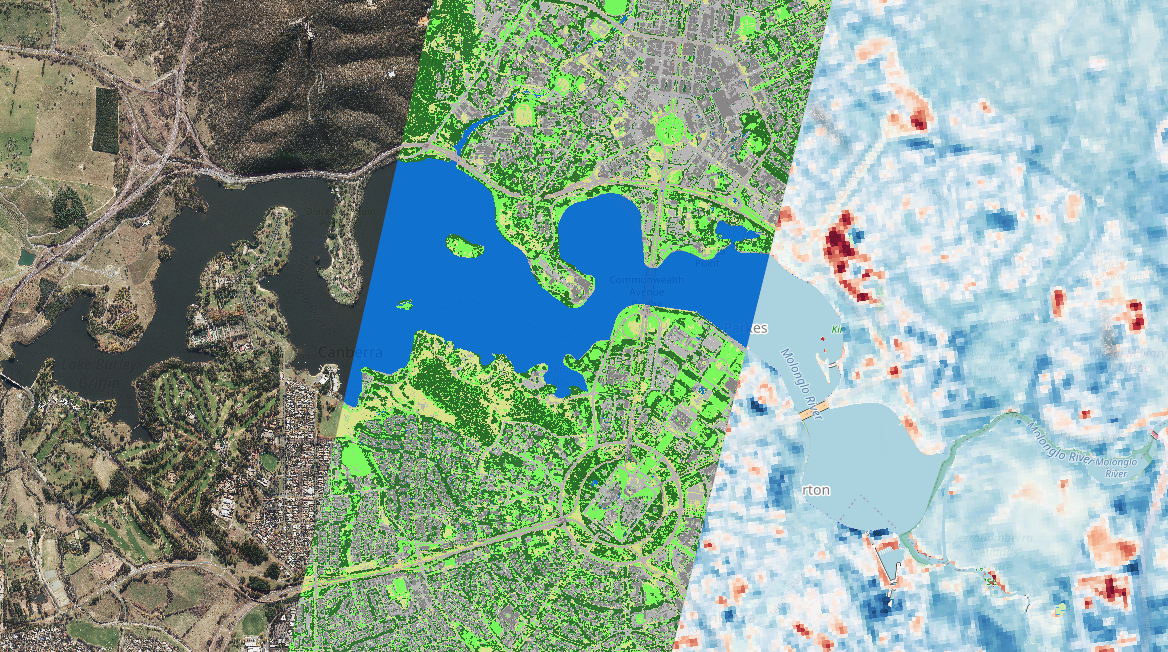
Analysis of land use change and biodiversity trends in the ACT
This report by the ACT Commissioner for Sustainability and the Environment evaluates the effects of urban development on land use, biodiversity, and environmental conditions in the ACT over the past 20 years. A full version of the report can be found here.
The data used in this report can be explored in this interactive mapping tool.
Key findings:
- Land Cover Change. The ACT's building footprint grew by 40% between 2004 and 2021, largely due to greenfield developments. The extent of threatened ecological communities Box-Gum Grassy Woodland and Natural Temperate Grassland declined by 129 ha (-1.9%) and 17 ha (-1.6%) during 2015–2023, respectively.
- Trends in Vegetation Condition. Vegetation condition in the ACT generally improved between 2004–2023, driven by recovery from the Millennium Drought and 2003 bushfires and recent wet years. However, urban developments led to localised vegetation loss, especially in Gungahlin, Molonglo Valley, and Jerrabomberra.
- Trends in Threatened Species and Communities. Urban development affected 29 of the ACT's 66 threatened species, including birds, mammals, reptiles, and insects. Five threatened bird species declined significantly from 2004–2017, including the Hooded Robin (-12% annually) and Glossy Black-Cockatoo (-23%).
- Attribution of Trends in Threatened Species and Communities. Urbanisation was not the sole driver of trends, but declines in Box-Gum Grassy Woodland and Natural Temperate Grassland species were linked to habitat loss, fragmentation, and edge effects exacerbated by urbanisation.
- Ecological Impacts of Future Developments. Potential developments in the northern and western ACT could threaten endangered ecological communities. Habitat fragmentation risks reducing ecological connectivity, further endangering species like the Golden Sun Moth and Pink-Tailed Worm-Lizard.
- Greenhouse Gas Emissions from Future Land Use Change. Urban development increases greenhouse gas emissions primarily through biomass and soil carbon losses, with annual losses of 0.5-4 tC per hectare depending on the original land cover.
- Mitigation options. Negative impacts from urban expansion are inevitable but can be reduced by enhancing habitat connectivity and reducing edge effects through strategic conservation planning, expanding biodiversity offset programs with measurable "net gain" objectives.
Full Citation
Van Dijk, A.I.J.M., Rapley, S., Chen, M., Rozas Larraondo, P., Gibbons, P. (2025) Analysis of land use change and biodiversity trends in the ACT. Report to the ACT Office of the Commissioner for Sustainability and the Environment. Haizea Analytics Pty Ltd and The Australian National University, Canberra.